
This title is currently out of stock. Leave us your email address, we’d let you know when it’s in stock again!
-

A note on book covers: while we do our best to ensure the accuracy of cover images, ISBNs may at times be reused for different editions of the same title which may hence appear as a different cover.

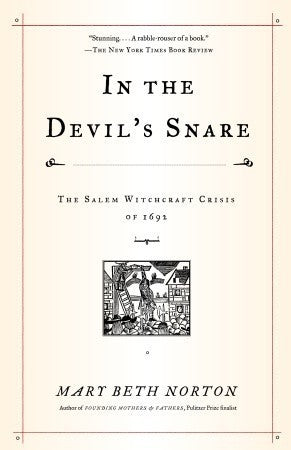
In The Devil's Snare: The Salem Witchcraft Crisis Of 1692
In The Devil's Snare: The Salem Witchcraft Crisis Of 1692
Couldn't load pickup availability
In 1692 the people of Massachusetts were living in fear, and not solely of satanic afflictions. Horrifyingly violent Indian attacks had all but emptied the northern frontier of settlers, and many traumatized refugees—including the main accusers of witches—had fled to communities like Salem. Meanwhile the colony’s leaders, defensive about their own failure to protect the frontier, pondered how God’s people could be suffering at the hands of savages. Struck by the similarities between what the refugees had witnessed and what the witchcraft “victims” described, many were quick to see a vast conspiracy of the Devil (in league with the French and the Indians) threatening New England on all sides. By providing this essential context to the famous events, and by casting her net well beyond the borders of Salem itself, Norton sheds new light on one of the most perplexing and fascinating periods in our history.
A note on book covers: while we do our best to ensure the accuracy of cover images, ISBNs may at times be reused for different editions of the same title which may hence appear as a different cover.
-
One Line Summary
Insightful analysis of Salem Witch Trials and colonial fears.
-
Who is this book for?
If you're interested in understanding the deeper social and political anxieties behind the Salem witch trials, this book offers a fresh perspective grounded in thorough research. Mary Beth Norton takes you beyond the basic story to explore how fears of Native American attacks and external threats fueled paranoia, making the trials a reflection of the troubled colonial psyche. It's a compelling read that reveals just how intertwined fear, politics, and religion were in shaping the tragic events.