
This title is currently out of stock. Leave us your email address, we’d let you know when it’s in stock again!
-

A note on book covers: while we do our best to ensure the accuracy of cover images, ISBNs may at times be reused for different editions of the same title which may hence appear as a different cover.

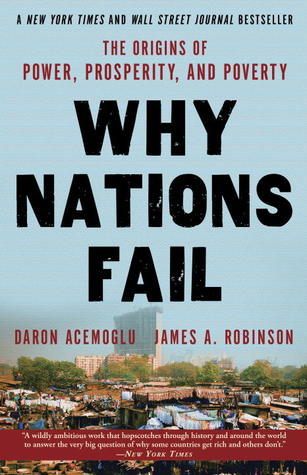
Why Nations Fail: The Origins Of Power, Prosperity, And Poverty
Why Nations Fail: The Origins Of Power, Prosperity, And Poverty
Couldn't load pickup availability
Is it culture, the weather, geography that determines prosperity or poverty? As Why Nations Fail shows, none of these factors is either definitive or destiny.
Drawing on fifteen years of original research, Daron Acemoglu and James Robinson conclusively show that it is man-made political and economic institutions that underlie economic success (or lack of it). Korea, to take one example, is a remarkably homogeneous nation, yet the people of North Korea are among the poorest on earth while their brothers and sisters in South Korea are among the richest. The differences between the Koreas is due to the politics that created those two different institutional trajectories. Acemoglu and Robinson marshal extraordinary historical evidence from the Roman Empire, the Mayan city-states, the Soviet Union, the United States, and Africa to build a new theory of political economy with great relevance for the big questions of today, among them:
- Will China's economy continue to grow at such a high speed and ultimately overwhelm the West?
- Are America’s best days behind it? Are we creating a vicious cycle that enriches and empowers a a small minority?
Details of Book
A note on book covers: while we do our best to ensure the accuracy of cover images, ISBNs may at times be reused for different editions of the same title which may hence appear as a different cover.
-
One Line Summary
Explores political institutions shaping national economic destinies.
-
Who is this book for?
If you're curious about why some countries flourish while others struggle, this book offers a compelling explanation. It dives into history and economics to show how institutions—more than culture or geography—shape a nation's prosperity. Readers have found it eye-opening and thought-provoking, especially if you're interested in understanding global inequalities and growth.